


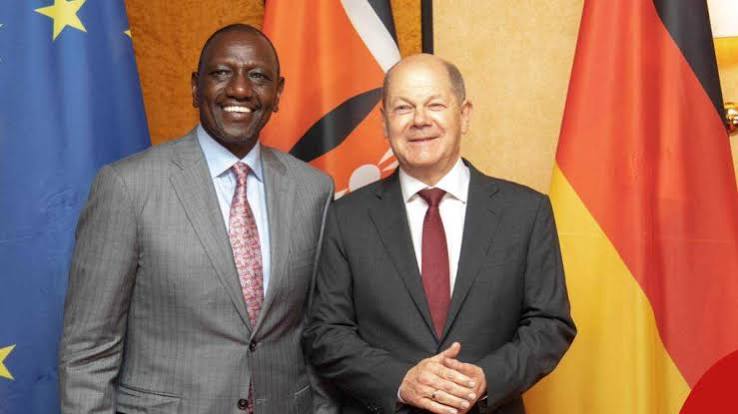
Kenya is seeking to expand employment opportunities for its citizens in Germany, with President William Ruto saying the country wants to tap into about 200,000 jobs available to foreign workers as Nairobi and Berlin move to strengthen their economic partnership.
The announcement followed a meeting between President Ruto and German President Frank-Walter Steinmeier at State House, Nairobi, on Wednesday, November 25, 2026, during which the two leaders discussed labour mobility, trade, investment, skills development and technology transfer.
The visit marks a renewed push to transform the longstanding Kenya-Germany relationship into a partnership that delivers tangible economic benefits, particularly for young people seeking employment and skills development opportunities.
Ruto said Germany had approximately 200,000 employment opportunities available to foreign workers, adding that Kenya was positioning its workforce to access as many of the opportunities as possible.
However, the figure represents opportunities available to foreign workers generally and is not a guaranteed employment quota for Kenyans. Applicants will still be required to meet German labour market and immigration requirements. Tuko.co.ke+1
A key outcome of the talks was the signing of a Memorandum of Understanding between the Kenyan government and German language examination and certification institution TELC.
The agreement is intended to make it easier for Kenyan job seekers to obtain recognised German language qualifications locally, reducing barriers that have previously limited access to employment opportunities in Germany.
The partnership will also support the introduction of German-language textbooks and vocational training materials into Kenyan learning institutions, curriculum development and improved training for German language teachers.
Ruto said language proficiency remained one of the major obstacles facing Kenyans seeking employment abroad, noting that the new arrangement would help prepare the country’s workforce for international opportunities.
The agreement was signed in the presence of the two presidents at State House.
The new initiative builds on the Comprehensive Migration and Mobility Partnership Agreement signed by Kenya and Germany in September 2024.
According to Ruto, the number of Kenyans employed in Germany increased from approximately 7,170 in March 2024 to 9,500 by March 2026.
The number of Kenyan trainees contributing to Germany’s social security system also rose from 820 to 1,260 over the same period.
The two governments agreed to explore ways of simplifying visa and recruitment procedures, improving language training and accelerating the recognition of professional qualifications.
They also discussed partnerships between Kenyan technical and vocational education institutions and German industries to equip young people with skills that match the demands of the German labour market.
The discussions further explored opportunities for Kenyan seafarers through specialised training, sea-time placements and partnerships with German shipping companies.
Beyond labour mobility, Germany has committed €52.5 million, equivalent to approximately KSh7.8 billion, in development cooperation funding for Kenya for the 2026–2028 period.
The funding will support cooperation in areas including renewable energy, agriculture, water and sanitation, infrastructure and technical and vocational education.
Ruto said Kenya was keen to move its relationship with Germany towards greater trade, investment, technology transfer and private-sector collaboration.
More than 120 German companies are already operating in Kenya, with the government seeking to attract additional investment in manufacturing, agro-processing, healthcare, infrastructure, renewable energy and digital technology.
The German business delegation accompanying Steinmeier is expected to explore investment opportunities in the country.
The two leaders also discussed expanding agricultural cooperation through mechanisation, irrigation, climate-smart farming, post-harvest management and cold-chain infrastructure.
The initiatives are expected to improve agricultural productivity, strengthen food security and increase the incomes of Kenyan farmers.
In the digital economy, the discussions covered artificial intelligence, cybersecurity, digital public infrastructure and scientific research, with both countries exploring partnerships between universities, research institutions and technology companies.
Kenya also sought German investment and expertise in geothermal energy, green hydrogen, energy storage and electricity infrastructure, with the aim of accelerating green industrialisation and expanding exports.
The leaders further discussed regional security, maritime cooperation, counter-terrorism and peace-support operations, as well as cultural relations, tourism and academic exchanges.
Steinmeier described Kenya as an important partner for Germany and said German investment, technology and expertise could contribute to Kenya’s economic development.
The German President’s visit comes as both countries seek to deepen cooperation in trade, investment, clean energy and skilled labour migration.
For Kenya, the immediate challenge will be to translate the employment target into accessible opportunities through proper training, transparent recruitment and the protection of workers seeking jobs abroad.The new TELC agreement provides a practical step towards addressing one of the barriers facing Kenyan applicants, while the broader partnership offers opportunities to expand investment and create employment within the country.
The success of the agreement will ultimately depend on how effectively the two governments implement their commitments and ensure that opportunities reach qualified Kenyan workers.